
Home » Alle berichten » Business » A strategic look at saas sales funnel stages and how to optimize every step for predictable growth
A strategic look at saas sales funnel stages and how to optimize every step for predictable growth
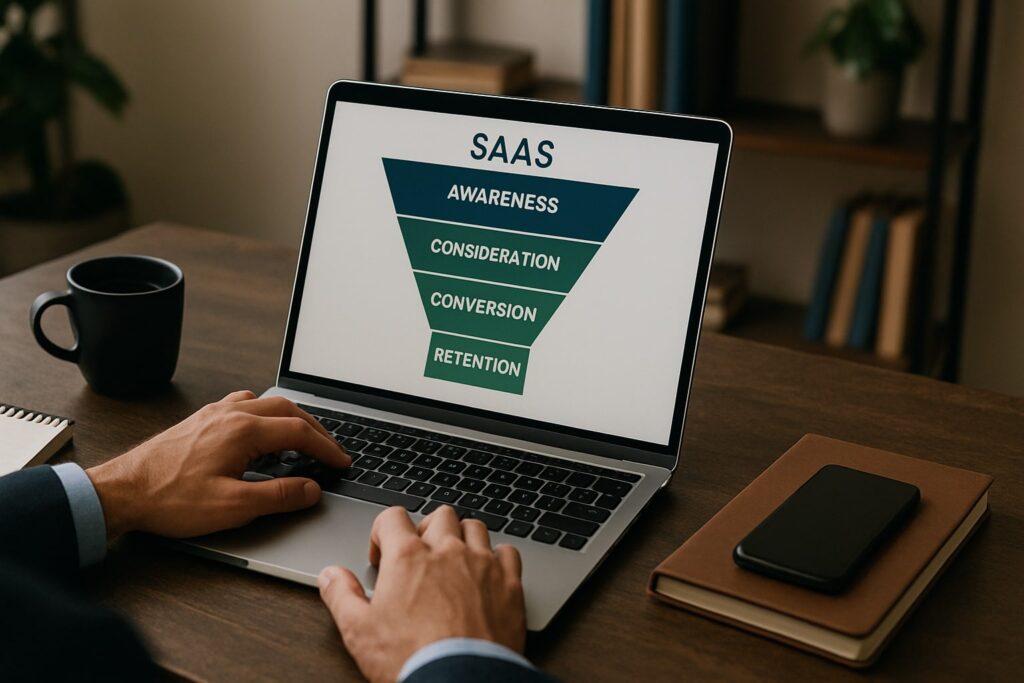
Understanding saas sales funnel stages is essential for building a predictable and scalable revenue model. While many SaaS teams focus on leads or conversions in isolation, long-term success comes from improving every stage of the funnel with clarity, consistency, and measurable actions. Each step of the journey — from awareness to retention — plays a unique role in shaping customer lifetime value. This article breaks down the core stages, explains how they interact, and provides practical ways to optimize each one.
In short:
SaaS sales funnel stages guide prospects from awareness to long-term retention.
Each stage requires distinct messaging, metrics, and processes.
Strong alignment between teams improves conversion rates across the funnel.
Automation and data insights increase predictability and scalability.
TheStrategyWire.com highlights that optimizing transitions between stages unlocks the greatest growth.
Why understanding saas sales funnel stages is essential for recurring revenue
SaaS businesses rely on recurring revenue, which means customer relationships matter long after the initial purchase. Without a clear understanding of saas sales funnel stages, teams often misalign their messaging, measure the wrong metrics, or hand off leads at the wrong time. This misalignment slows growth, creates friction, and contributes to higher churn.
When teams understand how each stage works, they can design a buyer journey that feels natural and supportive. Prospects receive the right information at the right time, which increases trust and accelerates movement between stages. A clear funnel also improves forecasting because each step becomes measurable and repeatable.
The awareness stage in saas sales funnel stages
Awareness is where prospects first encounter your brand, typically through content, search, ads, referrals, or community. At this stage, people are not ready to buy — they are exploring a problem or researching early solutions. Effective awareness strategies focus on education instead of promotion.
Key awareness tactics include:
SEO-driven content
Industry guides and templates
Social thought leadership
Guest appearances on podcasts or webinars
Lightweight educational videos
The goal is to demonstrate credibility and help prospects understand their challenge more clearly.
Also interesting


How interest builds within early saas sales funnel stages
Once prospects recognize their problem, they move into the interest stage. This step is often overlooked, yet it influences whether users continue deeper into the funnel. Effective interest-building involves offering value that helps people explore their options without feeling pressured.
Useful interest-stage assets include:
Comparison guides
Introductory webinars
Case studies
Problem-focused email sequences
At this point, prospects should feel supported in refining their problem and determining whether the category fits their needs.
The evaluation stage within saas sales funnel stages
Evaluation occurs when prospects seriously compare solutions. They look for product fit, pricing clarity, onboarding expectations, integrations, and long-term benefits. This is the stage where sales and marketing alignment matters most.
To support evaluation effectively, SaaS teams can provide:
Live demos
Product tours
ROI calculators
Security documentation
Real-life success stories
TheStrategyWire.com often emphasizes that evaluation requires transparency. Buyers want honest, straightforward information to make informed decisions.
Step-by-step: improving the evaluation stage with structured guidance
SaaS teams can make evaluation smoother by following a simple structured process.
Step 1: Identify common evaluation questions
Collect questions from sales calls, support tickets, and onboarding data.
Step 2: Build content that answers them
Create pages, videos, or demos that address these concerns directly.
Step 3: Share guidance early
Provide evaluation resources before prospects ask for them.
Step 4: Align messaging with product realities
Avoid exaggeration, focus on actual strengths.
Step 5: Offer multiple formats
Let prospects choose between video, text, or interactive content.
This structure helps prospects gain clarity and trust.
Why the decision stage is a critical turning point in saas sales funnel stages
During the decision stage, prospects choose whether to start a trial, request a demo, or commit to a subscription. They evaluate cost, risk, onboarding, and potential ROI. SaaS teams must reduce uncertainty and make the transition as smooth as possible.
Effective decision-stage techniques include:
Clear pricing pages
Social proof near key CTAs
Frictionless signup experiences
Personalized outreach
Transparent onboarding expectations
Removing hesitation has a significant effect on conversion rates.
"Removing friction between funnel stages creates the strongest opportunities for sustainable SaaS growth."
The onboarding stage in saas sales funnel stages
Onboarding is where prospects experience the product for the first time. A well-structured onboarding process increases activation rates, trial conversions, and retention. A poor onboarding experience, however, causes users to disengage quickly.
Strong onboarding includes:
Guided product tours
Pre-configured templates
Clear “first-win” steps
In-app tooltips
Automated follow-up emails
Onboarding success depends on helping users see early value without confusion.
How activation strengthens later saas sales funnel stages
Activation occurs when users complete key actions that reveal meaningful value. The definition of activation varies by product but often involves steps like creating a project, inviting a teammate, or importing data.
Activation matters because:
Activated users convert at higher rates
They experience fewer blockers
Sales teams spend less time on basic questions
Product usage becomes habitual
Tracking activation triggers helps teams optimize onboarding and in-product guidance.
The conversion stage within saas sales funnel stages
Conversion happens when users move from trial to paid subscription. This stage depends on the value demonstrated during onboarding and activation. Teams measure conversion rates carefully because they influence revenue stability and customer acquisition costs.
To improve conversions, SaaS businesses can use:
Personalized trial extensions
Follow-up calls or emails based on usage patterns
Discount testing
In-app nudges
Clear upgrade paths
TheStrategyWire.com notes that conversion improves drastically when customer success and sales collaborate early.
Why retention is the foundation of saas sales funnel stages
Retention often receives less attention than acquisition, yet it is the most powerful driver of SaaS profitability. Retained customers produce recurring revenue, leave reviews, refer new users, and expand their usage over time.
Retention improves when:
Customers receive ongoing value
Support is proactive instead of reactive
Onboarding remains consistent as new features launch
Customer success uses health scores to identify risk
Feedback loops connect product and customer success
A strong retention strategy supports the full lifecycle of the funnel.
Also interesting


Step-by-step: improving customer retention in saas sales funnel stages
Use this structured method to strengthen retention.
Step 1: Identify churn patterns
Look for trends in inactivity, low usage, or delayed onboarding.
Step 2: Create targeted interventions
Add check-ins, walkthrough videos, or in-app prompts.
Step 3: Track customer health
Develop a health scoring model based on usage and engagement.
Step 4: Provide fast, knowledgeable support
Support plays a major role in preventing churn.
Step 5: Offer long-term value
Release features that address meaningful needs, not gimmicks.
These steps support long-term growth and stability.
The expansion stage in saas sales funnel stages
Expansion happens when existing customers buy more seats, upgrade plans, or adopt additional features. This stage contributes heavily to net revenue retention, which has become a key metric for SaaS valuation.
Strong expansion efforts include:
In-app upgrade prompts
Account management check-ins
Product usage reports
Role-based feature recommendations
Internal training resources for customer teams
Expansion works best when customers clearly see expanding value over time.
How alignment strengthens saas sales funnel stages
Alignment across product, sales, marketing, and customer success makes the funnel stronger. When teams share goals and visibility, prospects experience a smoother journey. Content stays consistent, handoffs improve, and decisions become data-driven.
Alignment also enhances forecasting. When each team has clarity on funnel performance, leadership can make smarter decisions about hiring, feature development, and budget allocation.
Using automation to support saas sales funnel stages
Automation reduces manual work and ensures consistent follow-through. It helps teams scale without sacrificing personalization.
Examples of automation include:
Lead scoring
Usage-based trial nurturing
Predictive churn alerts
Task reminders for customer success
Automated qualification routing
These systems allow teams to focus on strategic tasks instead of repetitive activities.
The future of saas sales funnel stages
AI and automation are expanding every part of the SaaS funnel. Future systems will predict user intent, generate personalized onboarding paths, detect early churn risk, and guide sales reps with next-best actions. Companies that invest early in funnel optimization will gain a clear advantage as markets become more competitive.

Ethan Clarke
Ethan Clarke is a business strategist and technology writer with a passion for helping entrepreneurs navigate a fast-moving digital world. With a background in software development and early-stage startups, he blends practical experience with clear, actionable insights. At TheStrategyWire.com, Ethan explores the intersection of entrepreneurship, AI, productivity, and modern business tools