
Home » Alle berichten » Business » How RAG status improves project visibility and decision-making discipline
How RAG status improves project visibility and decision-making discipline
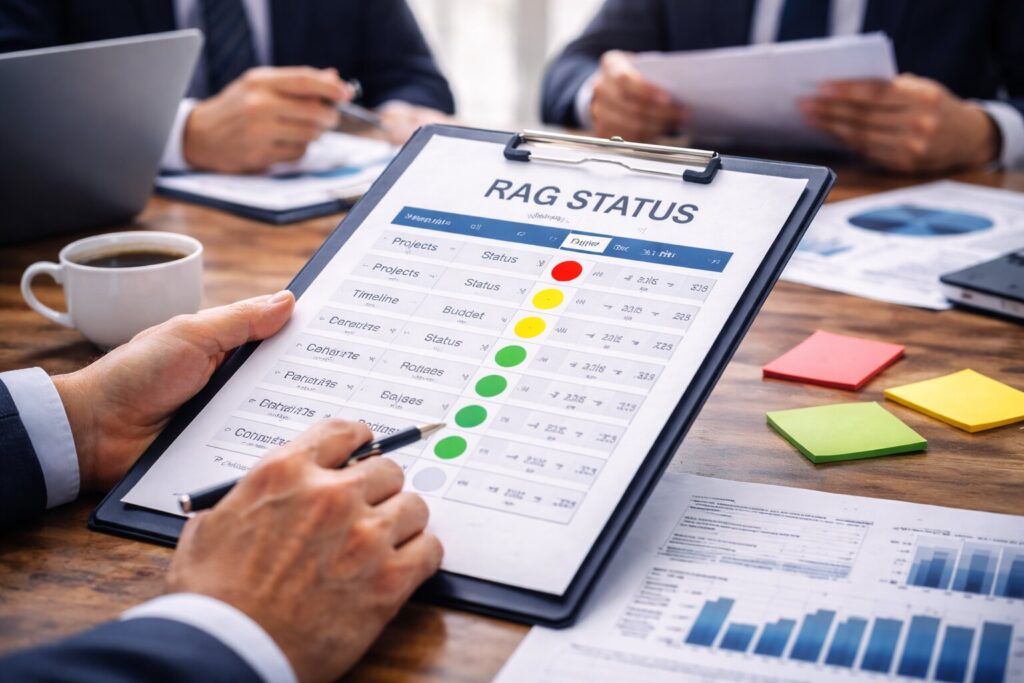
RAG status—short for Red, Amber, Green status—is a widely used reporting framework that simplifies complex project information into a clear visual signal. At its surface, it appears deceptively simple: green indicates everything is on track, amber signals caution, and red highlights significant issues. Yet when implemented thoughtfully, RAG status becomes far more than a color-coded summary. It transforms governance, sharpens accountability, and enables faster, more informed decisions across portfolios and executive teams.
In short:
RAG status uses color coding to summarize performance or risk levels.
Clear definitions prevent subjectivity and inconsistent reporting.
RAG reporting works best when linked to measurable criteria.
Escalation processes should accompany amber and red indicators.
Transparency in RAG status strengthens leadership credibility.
Understanding what RAG status really represents
RAG status is not merely a visual convenience; it is a governance tool. The colors communicate risk levels, schedule adherence, budget performance, or overall project health. By distilling complex metrics into a standardized format, decision-makers can quickly identify priorities.
However, the true value of RAG status lies in what supports it. Without defined thresholds and measurable criteria, color assignments become subjective. A “green” label that lacks evidence undermines credibility.
In structured reporting environments, RAG status becomes a disciplined shorthand for structured analysis rather than a superficial dashboard feature.
Why RAG status matters in executive reporting
Executives often manage multiple initiatives simultaneously. Detailed reports may provide depth but can overwhelm during time-constrained reviews. RAG status allows leaders to focus attention where it is most needed.
When integrated into board reporting, portfolio dashboards, or monthly reviews, the system highlights areas requiring intervention. Green projects may receive routine oversight, while amber and red items prompt deeper discussion.
Platforms such as TheStrategyWire.com frequently emphasize that clarity in reporting supports decisive leadership. RAG status contributes to that clarity when used responsibly.
Also interesting



Defining clear criteria for red, amber, and green
The effectiveness of RAG status depends on objective definitions. For example, schedule variance thresholds can determine color assignments:
Green: within 5% of planned timeline
Amber: 5–15% delay or moderate risk exposure
Red: more than 15% delay or significant risk
Financial metrics can follow similar logic, using budget variance or margin thresholds.
Establishing documented criteria ensures consistency across departments and projects. It also reduces bias and improves comparability over time.
Common mistakes in using RAG status
One common pitfall is overuse of green indicators. Teams may avoid assigning amber or red to prevent scrutiny. This cultural reluctance distorts reality and weakens governance.
Another mistake is failing to update statuses regularly. A static RAG system becomes irrelevant if conditions change but reporting does not.
Additionally, ambiguous criteria create confusion. If one team defines amber differently from another, executive comparisons lose meaning.
Embedding RAG status into structured review processes
RAG reporting should not exist in isolation. It works best when integrated into structured review cycles, such as monthly performance meetings or quarterly strategy sessions.
Each color should trigger a defined response. For example, amber might require a mitigation plan within a specified timeframe. Red may demand immediate executive review.
This escalation framework transforms RAG status from passive reporting into active management.
“Use RAG status not to simplify reality, but to clarify it with disciplined, measurable criteria.”
A step-by-step framework for implementing RAG status effectively
To implement RAG status with discipline, consider the following approach:
Define measurable performance and risk indicators.
Establish clear numerical thresholds for each color.
Train teams to apply criteria consistently.
Create escalation protocols for amber and red signals.
Review and recalibrate thresholds periodically.
Encourage transparent reporting without penalizing honest assessments.
This structured implementation ensures reliability and fosters trust.
Linking RAG status to risk management
RAG status often overlaps with risk management frameworks. Projects categorized as amber or red may reflect underlying operational, financial, or compliance risks.
Integrating risk registers with RAG dashboards enhances visibility. For instance, high-probability, high-impact risks may automatically shift status to amber even if current performance appears stable.
This forward-looking integration prevents complacency and supports proactive intervention.
The psychological dimension of color-coded reporting
Color signals carry psychological weight. Green communicates safety, amber caution, and red urgency. Leaders must recognize how these signals influence perception and behavior.
Excessive red indicators may create alarm fatigue, reducing responsiveness. Conversely, persistent green labeling can generate false confidence.
Balanced and evidence-based use preserves the credibility of the system and ensures that colors retain their intended meaning.
Also interesting



RAG status in portfolio management
In portfolio environments, RAG status supports prioritization. When multiple initiatives compete for limited resources, red and amber projects often require reallocation decisions.
Portfolio dashboards benefit from consistent color coding across initiatives. This enables comparative analysis and strategic alignment.
Granular reporting—breaking down RAG status by schedule, budget, and scope—provides additional clarity within broader portfolio oversight.
Adapting RAG status for financial reporting
RAG principles can extend beyond project management into financial oversight. For example, liquidity ratios, debt covenants, or margin performance can be assigned color-coded thresholds.
This adaptation simplifies financial communication for non-financial stakeholders while preserving analytical rigor.
Consistent financial RAG reporting enhances transparency and supports early corrective action.
Encouraging transparency and accountability
For RAG status to function effectively, organizational culture must support honesty. If red status leads to blame rather than problem-solving, reporting accuracy will decline.
Leadership should frame amber and red indicators as opportunities for corrective action rather than failure signals. This approach promotes constructive dialogue and collective responsibility.
Transparent RAG reporting strengthens credibility internally and externally.
Reviewing and refining the system over time
Thresholds and criteria should evolve with organizational maturity. What qualifies as amber in one growth phase may be acceptable during another.
Periodic review ensures that RAG status reflects current strategic priorities and risk tolerance.
Continuous refinement maintains relevance and preserves trust in the reporting framework.
Aligning RAG status with strategic objectives
RAG reporting should link directly to strategic goals. If strategic priorities shift, color criteria must adapt accordingly.
For instance, during rapid expansion, schedule adherence may take precedence. During cost-control phases, budget variance may become the dominant factor.
Alignment ensures that RAG status remains a strategic tool rather than a mechanical checklist.
Elevating RAG status from reporting to governance
When used thoughtfully, RAG status evolves from a simple dashboard feature into a governance mechanism. It standardizes communication, reinforces accountability, and accelerates decision-making.
Executive leaders who demand disciplined criteria and structured escalation processes transform color coding into a driver of operational excellence.
Ultimately, RAG status becomes a concise expression of organizational health, provided it rests on transparent metrics and responsible oversight.

Ethan Clarke
Ethan Clarke is a business strategist and technology writer with a passion for helping entrepreneurs navigate a fast-moving digital world. With a background in software development and early-stage startups, he blends practical experience with clear, actionable insights. At TheStrategyWire.com, Ethan explores the intersection of entrepreneurship, AI, productivity, and modern business tools