
Home » Alle berichten » Productivity » Capacity vs demand: how to balance supply and workload for sustainable performance
Capacity vs demand: how to balance supply and workload for sustainable performance
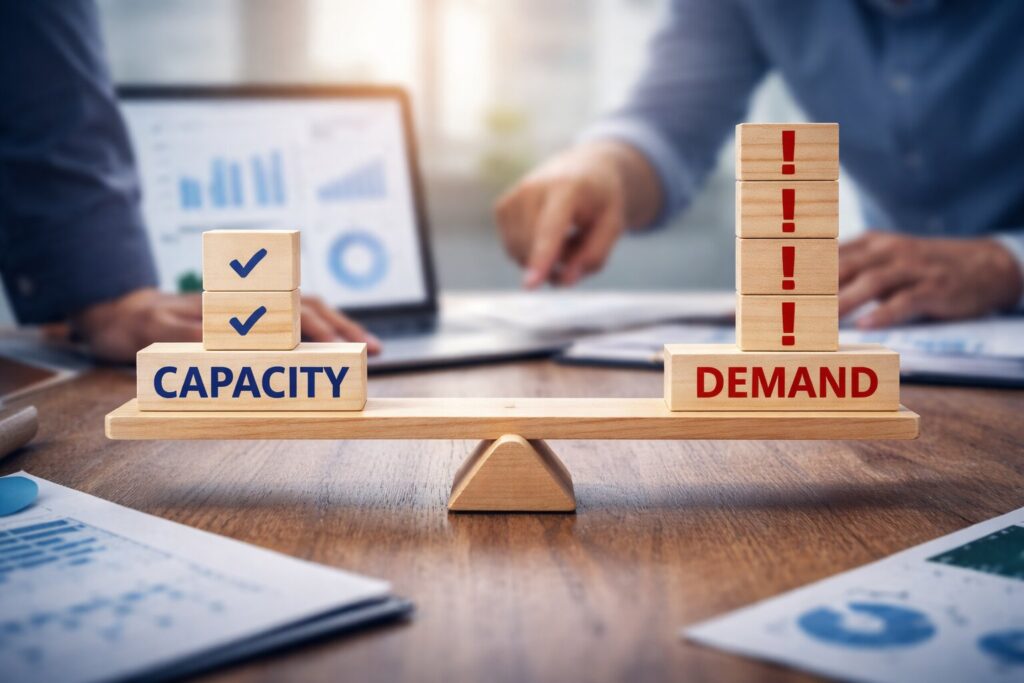
Every organization, regardless of industry, operates within the tension between capacity and demand. Capacity represents the available resources—people, time, infrastructure, capital—while demand reflects the volume of work, customer requests, or market needs placed upon those resources. When demand consistently exceeds capacity, burnout and delays follow. When capacity significantly exceeds demand, inefficiency and cost pressures emerge. Understanding capacity vs demand is therefore not a technical exercise, but a strategic necessity for maintaining stability, agility, and long-term performance.
In short:
Capacity vs demand defines the balance between available resources and required output.
Persistent imbalance creates either burnout or inefficiency.
Accurate forecasting reduces reactive decision-making.
Structured prioritization protects strategic initiatives.
Continuous monitoring strengthens resilience and scalability.
Understanding capacity vs demand in operational terms
Capacity refers to the maximum sustainable output an organization can deliver with its current resources.
Demand reflects the quantity and intensity of work required during a given period.
The relationship between capacity vs demand determines whether teams operate under strain, stability, or surplus conditions.
Why imbalance between capacity and demand creates systemic risk
When demand exceeds capacity for extended periods, quality declines. Deadlines slip, and employee fatigue increases.
Conversely, excess capacity reduces financial efficiency. Idle resources generate fixed costs without proportional returns.
Strategic stability requires deliberate management of this dynamic rather than reactive adjustments.
Also interesting


Measuring capacity accurately
Capacity is often misunderstood as headcount. However, availability varies based on skill level, experience, and competing responsibilities.
True capacity measurement accounts for productive hours, complexity of tasks, and non-billable responsibilities.
For example, a highly specialized engineer may represent more constrained capacity than several generalists.
Forecasting demand with discipline
Demand forecasting involves analyzing historical trends, sales pipelines, and market conditions.
Short-term demand often fluctuates, but strategic planning requires longer forecasting horizons.
Integrating quantitative data with qualitative insights improves prediction accuracy.
A structured process for balancing capacity vs demand
Organizations can apply a systematic approach:
Aggregate all incoming work requests.
Categorize demand by urgency and strategic importance.
Calculate realistic capacity per team or function.
Identify overload or surplus gaps.
Adjust through prioritization, redistribution, or resourcing decisions.
Review monthly or quarterly to recalibrate.
This structured process prevents reactive overload cycles.
"Balance capacity and demand with discipline, because sustainable growth depends on controlled alignment rather than reactive expansion."
The role of prioritization in managing demand
Not all demand carries equal strategic weight. Clear prioritization frameworks prevent low-impact tasks from consuming critical capacity.
Decision criteria may include revenue potential, risk mitigation, or regulatory necessity.
Transparent prioritization reduces internal conflict over limited resources.
Capacity vs demand in service-based environments
Service organizations often face volatile demand patterns.
Consulting firms, IT support teams, and healthcare providers must manage fluctuating client or patient volumes.
Flexible staffing models and buffer capacity protect service quality during demand spikes.
Managing surplus capacity strategically
Excess capacity should not automatically trigger cost-cutting. It can present strategic opportunity.
Organizations may invest surplus time in innovation, training, or process improvement.
At TheStrategyWire.com, operational case studies often show that leveraging surplus capacity during slow periods accelerates long-term competitiveness.
Also interesting



Workforce planning as a bridge between capacity and demand
Workforce planning aligns hiring decisions with projected workload.
Reactive hiring often results from sustained demand pressure.
Proactive workforce modeling anticipates shifts and prevents crisis-driven recruitment.
Technology’s role in balancing capacity vs demand
Digital tools enhance visibility into workload distribution.
Dashboards tracking utilization rates and backlog levels provide early warning signals.
Automation can expand effective capacity by reducing manual workload.
Psychological impact of sustained imbalance
When demand persistently exceeds capacity, morale declines.
Chronic overload increases turnover risk and erodes engagement.
Similarly, prolonged underutilization reduces motivation and skill development opportunities.
Balanced workload supports both performance and well-being.
Strategic buffers and contingency planning
No forecasting model eliminates uncertainty entirely.
Maintaining buffer capacity or flexible contractor arrangements mitigates risk.
Contingency planning ensures rapid adaptation when demand shifts unexpectedly.
Cross-functional coordination to prevent bottlenecks
Imbalance may occur unevenly across departments.
One team may face overload while another has surplus capacity.
Cross-functional visibility enables reallocation and reduces internal bottlenecks.
Financial implications of capacity misalignment
Overcapacity increases fixed costs without corresponding revenue.
Under-capacity may result in missed opportunities or delayed revenue realization.
Financial modeling supports informed decisions about scaling up or down.
Continuous review in dynamic environments
Markets evolve rapidly. Static planning quickly becomes outdated.
Regular capacity vs demand reviews ensure alignment with real-time conditions.
Adaptive governance structures sustain balance amid volatility.
Long-term sustainability through disciplined alignment
Organizations that continuously monitor and adjust capacity maintain resilience.
Strategic flexibility depends on understanding where slack or strain exists.
Sustainable performance emerges from deliberate alignment rather than constant expansion.

Ethan Clarke
Ethan Clarke is a business strategist and technology writer with a passion for helping entrepreneurs navigate a fast-moving digital world. With a background in software development and early-stage startups, he blends practical experience with clear, actionable insights. At TheStrategyWire.com, Ethan explores the intersection of entrepreneurship, AI, productivity, and modern business tools