
Home » Alle berichten » Business » Strategic planning vs operational planning: Turning vision into measurable execution
Strategic planning vs operational planning: Turning vision into measurable execution
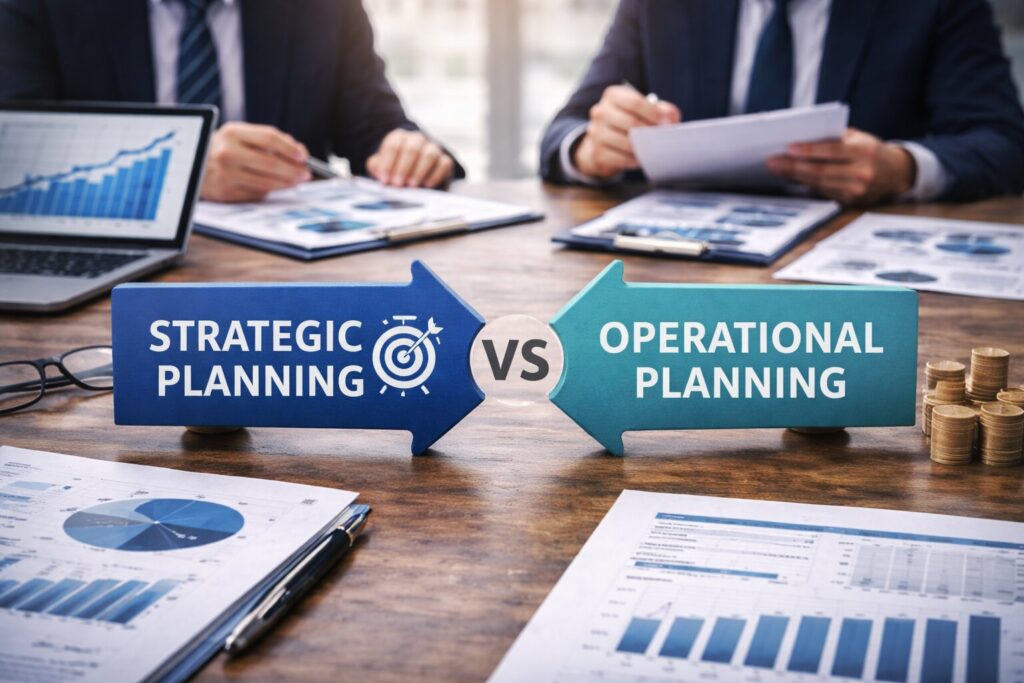
The distinction between strategic planning and operational planning is fundamental to sustainable performance. Strategic planning defines long-term direction, competitive positioning, and major priorities. Operational planning translates those priorities into concrete actions, budgets, and timelines. While they operate on different horizons, both must function in close alignment. When strategy is disconnected from operations, ambition becomes abstract. When operations lack strategic clarity, effort becomes fragmented. Understanding how these two planning layers interact is essential for disciplined growth and resilience.
In short:
Strategic planning sets long-term direction and competitive priorities.
Operational planning converts strategy into structured actions and targets.
Strategic planning focuses on “where and why”; operational planning on “how and when.”
Alignment between both prevents execution gaps.
Continuous review ensures adaptability without losing focus.
Understanding strategic planning at a high level
Strategic planning defines the organization’s long-term ambition and market positioning. It typically spans multiple years and addresses questions about growth pathways, differentiation, and capital allocation.
This planning level often includes market analysis, competitive assessment, and scenario modeling. Leaders determine which opportunities to pursue and which to avoid. Strategic planning clarifies priorities and sets boundaries.
Importantly, strategy does not specify daily tasks. Instead, it outlines direction, defining the framework within which operational decisions are made.
Understanding operational planning in practical terms
Operational planning translates strategy into actionable steps. It covers shorter timeframes—often quarterly or annual cycles—and specifies budgets, resource allocation, timelines, and measurable performance indicators.
For example, if strategic planning identifies expansion into a new market, operational planning determines hiring needs, marketing campaigns, infrastructure investments, and cash flow implications.
Operational planning answers how strategy becomes reality. Without it, strategic intent remains theoretical.
Also interesting



Strategic planning vs operational planning: Core differences
The primary difference between strategic planning and operational planning lies in scope and time horizon. Strategy looks outward and forward, focusing on competitive advantage and long-term positioning. Operations look inward and immediate, concentrating on efficiency and execution.
Strategic planning involves broad themes and directional objectives. Operational planning involves detailed schedules, budgets, and performance targets.
While the distinction is clear conceptually, in practice the two must remain tightly integrated to avoid misalignment.
Why strategic planning without operational discipline fails
A well-articulated strategy cannot deliver results unless supported by structured execution. Many organizations produce ambitious strategic documents that fail to influence daily activities.
This disconnect often occurs when operational plans are developed independently of strategic priorities. Departments may focus on local efficiency while neglecting broader direction.
Alignment ensures that operational metrics reflect strategic intent. When daily actions reinforce long-term goals, execution becomes coherent and measurable.
Why operational planning without strategic clarity creates drift
Operational excellence alone does not guarantee progress. Teams may execute tasks efficiently while moving in the wrong direction.
Without strategic clarity, resource allocation may prioritize short-term gains over long-term positioning. This misalignment can gradually erode competitive advantage.
Strategic planning provides the compass; operational planning provides the engine. Both are required for forward momentum.
“Let strategy define your destination and operations define your discipline, and progress will follow naturally.”
A step-by-step method to align strategy and operations
A structured cascade strengthens integration:
Define three to five long-term strategic priorities.
Translate each priority into measurable annual objectives.
Break annual objectives into quarterly operational targets.
Assign accountability for each initiative.
Link budgets and resources directly to strategic objectives.
Conduct regular reviews to adjust based on performance and market conditions.
This framework ensures coherence from high-level ambition to everyday tasks.
Financial integration between strategic and operational planning
Financial planning serves as a bridge between strategy and operations. Budgets allocate capital according to strategic priorities, reinforcing commitment to chosen directions.
Capital investments, hiring decisions, and technology upgrades should align with strategic goals. If financial resources are allocated inconsistently, strategic intent weakens.
Cash flow forecasting further supports alignment by ensuring that operational initiatives remain financially sustainable.
Performance measurement across planning layers
Performance metrics differ between strategic and operational planning. Strategic indicators often focus on market share, long-term growth, innovation milestones, or competitive positioning.
Operational metrics emphasize efficiency, productivity, cost control, and short-term revenue targets.
Integrating both sets of indicators into a unified dashboard provides balanced oversight. As highlighted on TheStrategyWire.com, integrated performance systems strengthen transparency and accountability.
Also interesting



Governance structures that reinforce alignment
Strong governance ensures that both planning layers remain connected. Executive leadership must regularly review progress against strategic priorities while monitoring operational execution.
Cross-functional coordination prevents silos. Strategy discussions should inform operational meetings, and operational insights should inform strategic revisions.
Clear documentation of decisions and outcomes enhances discipline and reduces ambiguity.
Adapting to uncertainty while preserving direction
Strategic planning often spans multiple years, yet markets evolve quickly. Operational plans must therefore remain flexible while preserving strategic coherence.
Rolling forecasts and scenario analysis help adjust execution without abandoning core direction. For example, economic downturns may require cost adjustments while maintaining long-term investment commitments.
Adaptability strengthens resilience without undermining clarity.
Cultural factors in strategic and operational planning
Culture significantly influences planning effectiveness. A culture of accountability ensures that operational targets are taken seriously.
Open communication about performance gaps fosters learning rather than blame. Continuous improvement becomes embedded in daily routines.
When culture aligns with planning discipline, strategic intent translates more smoothly into operational outcomes.
The leadership role in bridging both planning types
Leadership sets expectations for integration. Executives must communicate strategic priorities clearly and ensure operational leaders understand their role in achieving them.
Regular alignment meetings, transparent metrics, and collaborative problem-solving reinforce cohesion.
Effective leadership treats strategic and operational planning not as separate exercises but as interconnected responsibilities.
Long-term value creation through integrated planning
The true value of comparing strategic planning vs operational planning lies in understanding their interdependence. Strategy defines direction; operations deliver progress.
When both layers reinforce each other, organizations move with clarity and momentum. Fragmentation, by contrast, leads to inefficiency and missed opportunities.
Integrated planning creates stability, adaptability, and measurable performance.

Ethan Clarke
Ethan Clarke is a business strategist and technology writer with a passion for helping entrepreneurs navigate a fast-moving digital world. With a background in software development and early-stage startups, he blends practical experience with clear, actionable insights. At TheStrategyWire.com, Ethan explores the intersection of entrepreneurship, AI, productivity, and modern business tools